Effluent Plant Eating Your Budget in Chemicals, Sludge and Fines? Where Enzyme Blends Pay Off
The big running costs of a factory effluent plant are chemical dosing, sludge haulage and the bill for putting things right after a discharge exceedance. When the biology underperforms, the usual reflex is to dose more chemical, and that brings more sludge, more cost and secondary pollution. An enzyme blend is meant to work on all three lines at once: lower chemical consumption, lower sludge volume and a steadier system. This page sets out where that holds, where it fails, and what to check before you spend anything. If you already have lab figures, send us your effluent profile by email for a bench-trial blend recommendation and a quote.
The money case, stated honestly
Operating costs 20-30% lower is the headline claim made for wastewater enzyme programmes, and it is a reported claim with no plant conditions attached, so treat it as something to test and not as a budget line. The first objection from any operations manager is that the enzyme itself looks expensive. The answer is a ledger: saved chemical, saved sludge haulage and avoided rework on one side, enzyme spend on the other. The saving must come from better treatment, never from skipping maintenance or quietly cutting the chemical dose.
Inside a working biological stage the reported gain is modest: COD removal up by 8-12% and operating cost down by 10% or more. That is the size of an add-on to healthy biology, and it is small enough that you need before-and-after measurements to see it. The wider direction is the same everywhere: biological treatment taking over from chemical dosing to cut sludge and keep discharge compliant with less chemical dependency.
Two places an enzyme earns its keep
Inside the plant
A wastewater blend is normally a composite of protease, lipase, amylase and cellulase. Each one cuts a different part of the load, protein, fat, starch and fibre, into pieces the bacteria can take up faster. The blend is often packaged together with bacteria, and it is sold with technical service because choosing the right mix is part of the job. Blends are formulated by industry, with different mixes for livestock, textile, domestic and mixed industrial effluent. What you are comparing between offers is fit to your own water quality, process and load, not a catalogue grade.
Anaerobic digesters are a separate case. Enzyme additives there speed up hydrolysis, making cellulose, hemicellulose, starch, proteins and fats more accessible to the microbial community. They are not universally effective: the result depends on the feedstock and on whether hydrolysis is really the bottleneck, and an excessive dose can inhibit the digester.
Before the plant
The cheapest load to treat is the load that never reaches the effluent plant. Textile desizing is the clearest example. Caustic desizing produces wastewater with a COD of 3000–8000 mg/L, needs heavy biological treatment downstream and damages cotton fibre by 5–15%. Replacing caustic with a neutral cellulase blend is reported to cut that COD by 40–60%. In one mill case the desizing effluent went from 6800 to 3100 mg/L COD, a 54% drop, with downstream chemical use cut 35% and total cost reduced 22%. That case ran a warm, mildly acidic bath, far gentler than caustic, with 0.5–2 kg of enzyme per ton of fabric adjusted for water hardness. It is one mill under its own conditions, so use it to size a trial and not as a promise.
A related offer for small and mid-sized cotton mills pairs neutral cellulase with amylase and claims a COD reduction of 60% or more against the caustic soda method. The time to look at the switch is when your COD average sits close to the discharge limit month after month, or when caustic-route water and chemical costs start to hurt your quotes. A hot, strongly alkaline line cannot switch directly; the equipment has to change first.
Residual hydrogen peroxide is the second source-side problem. Peroxide left over from bleaching or oxidation steps harms the biology downstream, and catalase breaks it down to water and oxygen. Catalase products positioned for industrial effluent are dosed directly into the wastewater. The right activity and dose depend on the peroxide concentration, the flow, the pH and the temperature.
Food and starch plants have their own profile. A potato starch mill generates about 20 tons of wastewater per ton of starch, high in protein and with a COD of 6000–30000 mg/L. The mistake is to treat all of it as one stream: the protein-rich water is the heavy part, and wash water can be recycled. Recover the protein first and let biology handle what is left; an amylase and protease blend supports that recovery step at small and medium mills.
Kitchen and canteen grease traps on a factory site are a smaller version of the same question: enzymes work on grease slowly and do not shift carbonised deposits.
What goes in the blend, and what it will not do
| Effluent problem | Enzymes involved | What it does | What it will not do |
|---|---|---|---|
| Tired activated sludge, rising chemical and sludge cost | Protease, lipase, amylase, cellulase, often with bacteria | Modest extra COD removal, lower chemical use | Fix a wrong wasting rate or F/M ratio |
| High COD from textile desizing | Neutral cellulase with amylase, in place of caustic | Cuts the load before it reaches the plant | Work on a hot, strongly alkaline line without equipment changes |
| Residual hydrogen peroxide | Catalase | Removes peroxide ahead of the biology | Hold up in high-salt effluent without a fit test |
| Starch and protein process water | Amylase, protease | Supports protein recovery and breakdown | Replace separating the protein stream from wash water |
| Grease in kitchen traps and drain lines | Lipase with bacteria | Liquefies and digests grease over time | Act instantly or shift carbonised, baked-on grease |
| Slow anaerobic digester | Cellulase and hemicellulase types | Speeds hydrolysis when that is the bottleneck | Help when hydrolysis is not the limit |
Where enzyme programmes fail
The additive as a band-aid. Experienced operators are blunt about it: "Anything that you add vs adjusting MLSS for proper MCRT and or return rates is a band-aid." Their point is that correct wasting and return rates give you the right sludge age and F/M ratio, and an additive only belongs when the plant has gone far out of balance. Another asks whether it would be more cost effective to control F/M through proper wasting. Anything that artificially improves settling will also distort your settling test and SVI reading, so you can lose sight of the real state of the sludge. Get the process right first, then trial the enzyme on top.
Too little to matter. The sceptic's case against plain bacteria and enzyme additives is short: "There aren't nearly enough bacteria to make a difference." A small dose set against the biomass already in the system changes nothing, which is why a blend should be judged on measured results in your water and not on the label.
High-salt, high-COD effluent. High salt and high COD inhibit standard enzyme activity, so peroxide breakdown becomes unreliable unless the product has been adapted and tested for that water. The usual mistake is a generic dose with no bench test across the real salt, COD and pH range of the effluent. In salty water the dose may need to go up or the contact time may need to be longer, and because effluent varies, monitoring has to continue after start-up.
Expecting enzymes to replace process control. A blend that adds a modest share of COD removal cannot stand in for aeration, sludge management or pH control. On the desizing side the common failures are a bath that is too alkaline, temperature swings, and a poor rinse that leaves enzyme behind to disturb later bleaching.
Expecting instant results on grease. Enzyme and bacterial treatments do not clean instantly; they liquefy and digest grease over time, and they are not strong enough for carbonised deposits. A fair worry from trap owners is whether the product only moves grease along to harden further down the line, so check the downstream drain as part of any trial.
Poor storage. Enzyme kept in heat or light, or left in an opened pack, loses strength before it reaches the tank.
What to ask before you commit
- Ask for a trial on your own water data. A fit test on your real effluent comes before any dosing plan.
- Ask for experience at the same type of site. Lab data alone is not enough, least of all for high-salt effluent.
- Ask who monitors and adjusts the dose after start-up. Effluent changes, and the dose has to follow it.
- Compare total cost, not unit cost. Count chemicals, sludge haulage and rework alongside the enzyme.
- Ask how the blend is matched to your industry and load. A custom scheme for your water quality and process beats a general-purpose product.
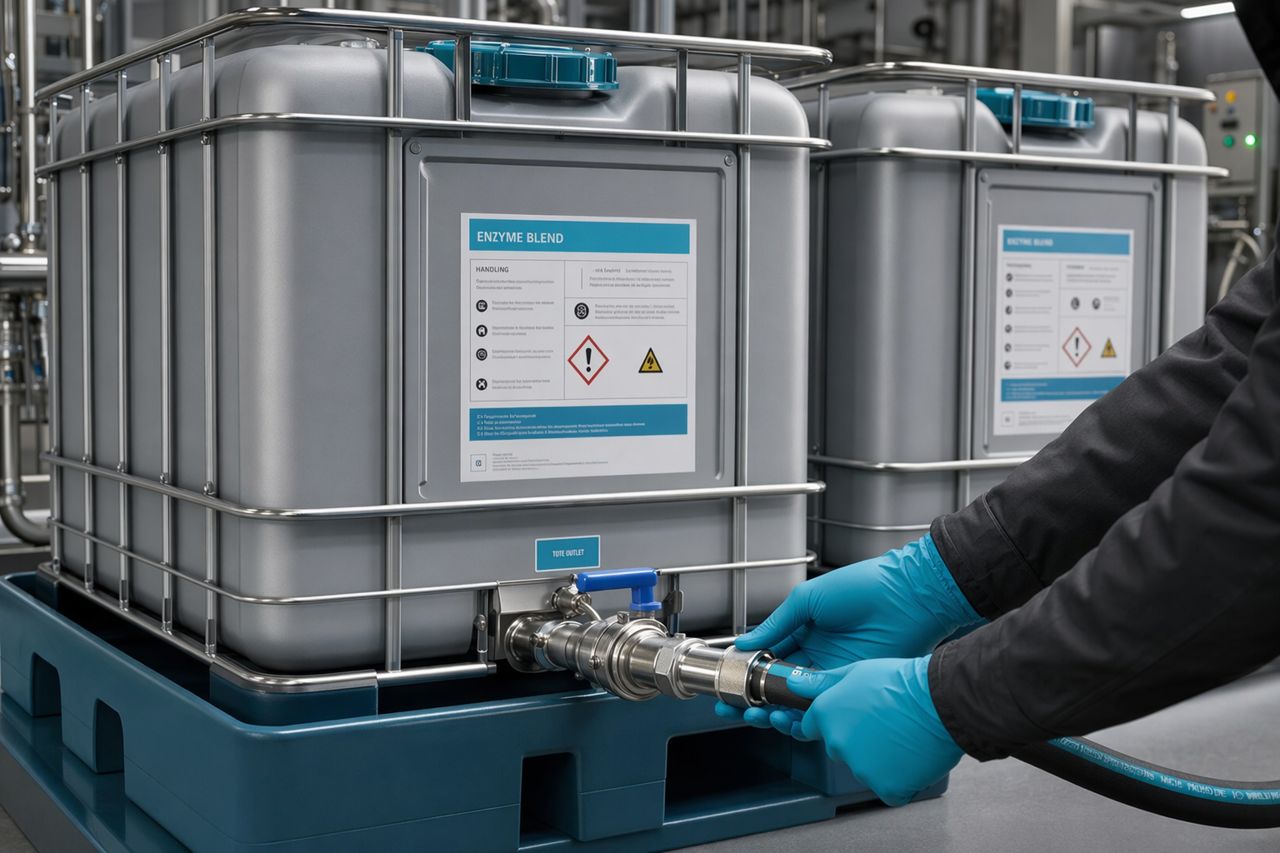
- Check the pack format against your consumption. Liquid enzyme for mills comes in 25 kg drums or 1125 kg IBC totes, and catalase for effluent is offered in drums, totes and bulk.
- Agree what will be measured. Record COD, sludge volume, chemical use and SVI before and after, so the result is a number and not an impression.
- Do not accept a dose from a brochure. For a wastewater blend the dose comes with the bench-trial plan, set on your flow and load.
Next step
Email us your effluent profile: flow, COD, BOD, fats and grease, salt, pH, temperature and your discharge limit. We reply with a bench-trial blend recommendation, a trial checklist and a quote for the pack size that fits your consumption.
Send your effluent profile through the on-site form
Further reading
- BOD/COD Shock Load Enzyme Programs | Bulk Blends
- FOG Reduction Enzymes for Grease Traps, Lift Stations, and DAF Pretreatment
- Bulk Enzyme Blends for Food & Beverage Wastewater
- Belt Press vs. Centrifuge Sludge Conditioning
- BOD, COD, and FOG Explained for Wastewater Managers
- Why DAF Units Get Overloaded in Food Processing Plants
- Equalization Tank Troubleshooting for Variable Industrial Effluent
- Grease-Trap FOG Audit Checklist for Industrial Sites
- High-Strength Wastewater from Dairies, Breweries, and Bakeries
- Odor Control in Lift Stations and Grease Interceptors
- What Drives Sludge Hauling Costs at Industrial Wastewater Plants?
- Industrial Park Pretreatment: Managing Multiple Wastewater Contributors
- Bulk Enzyme Blends for Sludge Dewatering Plants
- Textile Desizing Wastewater: Enzymes vs. Caustic Soda for COD Control