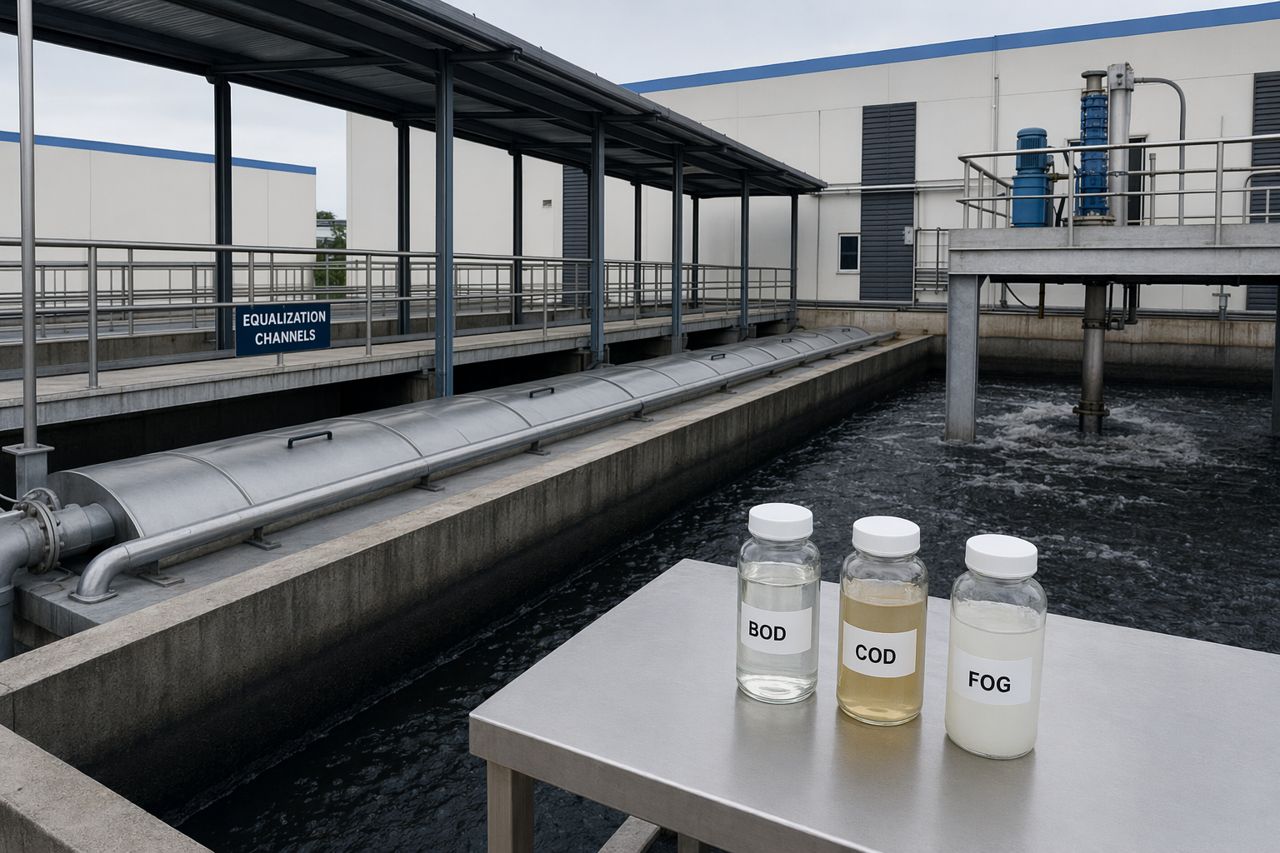
BOD, COD, and FOG Explained for Wastewater Operations Managers
BOD, COD, and FOG are more than lab numbers. For an operations manager, they are early-warning signals for surcharge risk, aeration stress, sludge growth, odor complaints, pretreatment limits, and the stability of the whole wastewater program.
This guide translates the three most common organic-load metrics into operational and purchasing decisions: how to run equalization, when to protect downstream biological treatment, where pretreatment is carrying the load, and when a targeted enzyme program may be worth buying. It is written for plant managers, environmental managers and the water-treatment distributors who advise them.
Buying for a plant or reselling to plants? Bulk enzyme blends are quoted per order. Send your industry, recent BOD/COD/FOG readings if you have them, the approximate quantity per month and the delivery country through the inquiry form.
For plants evaluating bulk enzyme blends for industrial wastewater treatment, understanding these metrics is the starting point. The right blend is not selected by a brochure claim. It is selected by wastewater profile, bottleneck, temperature range, residence time, pH window, cleaning chemistry, and the business outcome you need.
The quick definitions
BOD: what biology can consume
Biochemical Oxygen Demand, or BOD, estimates how much oxygen microorganisms need to break down biodegradable organic material in the wastewater.
In plain terms: BOD tells you how much food is available for the biology.
High BOD can mean:
- More aeration demand
- Higher energy use
- More biological sludge growth
- Greater risk of dissolved oxygen dips
- Increased surcharge or permit pressure
- More sensitivity to flow and load swings
BOD matters most when you are managing biological treatment capacity, aeration control, sludge handling, and compliance stability.
COD: the total oxidizable load
Chemical Oxygen Demand, or COD, estimates the oxygen equivalent needed to chemically oxidize organic and some inorganic material in the wastewater.
In plain terms: COD tells you the broader strength of the waste stream.
COD is often faster to track than BOD and can help operators spot load changes before they become downstream problems. COD includes material that may not be readily biodegradable, so it is usually higher than BOD.
High COD can indicate:
- Concentrated process losses
- Poor segregation of high-strength streams
- Cleaning or dump events entering the drain
- Excess organic loading to pretreatment or biological treatment
- More demand on equalization and operator response
FOG: fats, oils, and grease
FOG includes fats, oils, greases, waxy residues, and related hydrophobic material that can separate, float, coat surfaces, or accumulate in collection and treatment systems.
In plain terms: FOG tells you what may stick, float, blind, coat, or form mats.
High FOG can contribute to:
- Lift station buildup
- Pipe and screen fouling
- Equalization tank scum layers
- Poor DAF performance
- Odor formation in stagnant zones
- Reduced oxygen transfer efficiency
- Greasy sludge that is harder to dewater
FOG is often a physical handling problem before it becomes a biological treatment problem.
How BOD, COD, and FOG work together
No single number gives the full operating picture. The relationship between the three is where the useful decisions start.
High BOD and high COD
This usually points to a strong organic load. If the BOD portion is large, biological treatment may be able to consume much of it, but aeration and sludge systems must be sized and operated for the load.
Operational focus:
- Smooth load swings through equalization
- Prevent shock loads into aeration
- Confirm oxygen delivery capacity
- Watch sludge age and settling
- Identify high-strength process losses upstream
High COD with lower BOD
This can suggest material that is less readily biodegradable, chemically resistant, or influenced by cleaning agents, solvents, additives, or recalcitrant organics.
Operational focus:
- Review chemical usage and batch discharge timing
- Segregate difficult streams where possible
- Avoid assuming biology alone will solve the issue
- Evaluate pretreatment or source reduction
- Track whether COD spikes align with sanitation, CIP, or dump events
High FOG with elevated BOD or COD
FOG can carry a large organic load while also creating physical treatment problems. Grease buildup may reduce tank volume, interfere with pumps, and create scum layers that turn a manageable loading issue into a reliability issue.
Operational focus:
- Improve solids and grease capture upstream
- Maintain skimmers, screens, traps, and DAF systems
- Prevent stagnant grease zones
- Keep equalization mixed enough to avoid mats
- Consider targeted enzyme support where residence time and conditions allow
What these metrics mean for equalization
Equalization is the operations manager’s buffer between production reality and treatment stability.
When BOD or COD spikes, equalization helps dilute and meter the load into downstream systems. When FOG spikes, equalization can either protect the plant or become a grease storage problem, depending on mixing, temperature, retention time, and maintenance.
Use BOD, COD, and FOG trends to answer practical questions:
- Are high-strength events predictable by shift, batch, or sanitation schedule?
- Is equalization sized for the real peak load, not just average flow?
- Are floating layers forming before the wastewater reaches pretreatment?
- Is pH adjustment happening before biology is exposed?
- Are shock loads being blended or simply passed downstream?
A well-run equalization strategy often reduces the need for emergency responses later in the plant.
What these metrics mean for pretreatment
Pretreatment equipment is often judged by removal efficiency, but operations managers also need to judge it by stability and recoverability.
For FOG-heavy wastewater, pretreatment may include screens, traps, dissolved air flotation, coagulants, flocculants, pH adjustment, or temperature control. When FOG is not captured or conditioned correctly, downstream aeration may receive a load it was not designed to handle.
Watch for signs that pretreatment is under stress:
- Grease carryover after separation
- Floating solids in equalization
- DAF float changes in texture or volume
- Sudden chemical demand increases
- Odor from retained organic material
- Sludge that becomes oily, sticky, or slow to dewater
Enzyme programs are sometimes used to help condition organic residues before or within pretreatment. They should be evaluated as part of a process plan, not as a replacement for good mechanical separation and housekeeping.
What these metrics mean for aeration
Aeration systems respond directly to biodegradable load. When BOD rises, oxygen demand rises. If the plant cannot deliver oxygen fast enough, treatment efficiency can fall and odors can appear.
Key operating concerns include:
- Dissolved oxygen control
- Blower energy use
- Oxygen transfer efficiency
- Mixed liquor stability
- Filament or bulking risk
- Sludge yield and wasting rate
- Recovery time after shock loads
FOG can create an additional challenge by coating surfaces, reducing transfer efficiency, and slowing biological access to the organic load. In some systems, breaking down grease into more accessible material can support more stable treatment, but only when the downstream biology has enough oxygen, time, and capacity to complete the job.
What these metrics mean for sludge production
Organic load becomes treatment output. Some is converted to carbon dioxide and water. Some becomes biomass. Some becomes float, scum, or sludge.
High BOD typically increases biological sludge production. High FOG can make sludge more difficult to handle. High COD from less biodegradable materials may pass through, accumulate, or create treatment stress depending on the process.
Operations managers should connect lab trends to sludge handling costs:
- More hauling
- More polymer demand
- Slower dewatering
- Oily cake or poor solids release
- More scum management
- Increased labor for cleaning and maintenance
A treatment program that lowers visible grease but increases uncontrolled downstream load is not a win. The goal is a balanced system: better conditioning, steadier biology, manageable sludge, and predictable compliance performance.
Where enzyme blends can fit
Bulk enzyme blends for industrial wastewater treatment are typically evaluated when a plant is dealing with persistent organic residues, FOG accumulation, load variability, odor precursors, or pretreatment inefficiency.
Enzymes are catalysts. They help break targeted organic materials into smaller components that downstream treatment can handle more consistently. In wastewater applications, enzyme blend selection may focus on fats, oils, grease, proteins, starches, fibers, or mixed food and process residues.
A practical enzyme program can support:
- Grease conditioning in collection or equalization areas
- Improved access to trapped organic material
- Reduced buildup in low-flow or high-FOG zones
- Better consistency ahead of DAF or biological treatment
- Smoother organic loading when used with equalization control
- Reduced manual cleanout pressure in selected problem areas
The important word is support. Enzymes do not replace hydraulic control, solids management, pH control, aeration capacity, or equipment maintenance. They work best when integrated into the operating plan.
What to review before requesting an enzyme quote
A useful quote starts with process context. Before requesting pricing, gather the information that helps technical teams recommend the right blend and feed strategy.
Helpful details include:
- Industry and production process
- Average and peak wastewater flow
- Current BOD, COD, and FOG trends
- Known spike events or seasonal changes
- Temperature and pH range
- Equalization volume and mixing approach
- Pretreatment equipment in place
- Aeration or biological treatment type
- Current pain point: surcharge, odor, FOG buildup, sludge, compliance, or maintenance
- Desired buying format, storage constraints, and dosing location
The more specific the operating problem, the more specific the enzyme recommendation can be.
Common decision scenarios
Scenario 1: FOG buildup is driving maintenance cost
If grease is accumulating in lift stations, wet wells, screens, or equalization tanks, the first step is to confirm where the material is entering and whether mechanical capture is being maintained. A targeted enzyme blend may help condition residual FOG where residence time, mixing, and temperature are suitable.
Scenario 2: BOD spikes are stressing aeration
If BOD spikes line up with batches, sanitation, or product changeovers, equalization and discharge scheduling are the first controls. Enzyme support may help convert specific organic residues more consistently, but the aeration system still needs enough oxygen and retention time.
Scenario 3: COD remains high after pretreatment
If COD is high but BOD is not rising proportionally, the load may include less biodegradable or chemically influenced material. Review cleaning chemistry, process additives, side streams, and source segregation before assuming an enzyme blend is the main solution.
Scenario 4: Sludge handling is becoming expensive
If sludge volume, texture, or dewatering performance has changed, compare the timing with FOG, BOD, COD, chemical feed, and production changes. The goal is not only removal, but a solids profile the plant can handle predictably.
The operations manager’s takeaway
BOD, COD, and FOG are decision tools:
- BOD helps you understand biological oxygen demand and treatment capacity.
- COD helps you see total waste strength and load changes.
- FOG helps you manage grease, separation, buildup, and downstream interference.
Together, they help you decide when to adjust equalization, protect pretreatment, stabilize aeration, plan sludge handling, and evaluate enzyme support.
If your plant is reviewing enzyme options, start with the bottleneck. Is the issue buildup, shock load, surcharge, sludge, odor, or compliance margin? From there, a technical quote can be built around your wastewater profile and operating goals.
Request a quote
Ready to discuss a plant-specific enzyme blend? Use the on-site request form and share your wastewater profile, current BOD/COD/FOG trends, and the operating problem you want to solve.