Belt Press vs. Centrifuge: What Changes for Sludge Conditioning?
For an industrial wastewater treatment plant, dewatering equipment is not just a mechanical choice. It changes how sludge is conditioned, how operators respond to feed swings, how much polymer is consumed, and how predictable cake handling becomes.
This guide compares belt presses and centrifuges from the perspective of sludge conditioning, for the people who pay for the result: plant managers watching polymer and haulage costs, and the distributors and service contractors who supply those plants. It also shows where bulk enzyme blends for industrial wastewater treatment can fit into a practical, plant-level program.
Supplying dewatering sites? Bulk enzyme blends are quoted per order. Send your dewatering equipment type, the main sludge source, the approximate quantity per month and the delivery country through the inquiry form.
Short version: a belt press is typically more visible and adjustable during operation, while a centrifuge is more enclosed and shear-intensive. Both can work well, but they reward different conditioning strategies.
Why dewatering equipment changes the conditioning plan
Sludge conditioning is the bridge between upstream treatment and mechanical water removal. The same sludge can behave differently depending on whether it enters a gravity zone and belt compression path, or a high-speed centrifuge bowl.
Key variables include:
- How floc forms before dewatering
- How stable the floc remains under shear
- How quickly free water separates
- How much polymer is required to hold structure
- How consistently feed solids, fats, proteins, starches, surfactants, or process residues arrive
- How easily the final cake can be conveyed, stored, or hauled
Enzyme blends do not replace mechanical design or polymer chemistry. In the right application, they can help reduce the burden created by difficult organic loading upstream of the press or centrifuge.
Belt press sludge dewatering: what operators usually notice
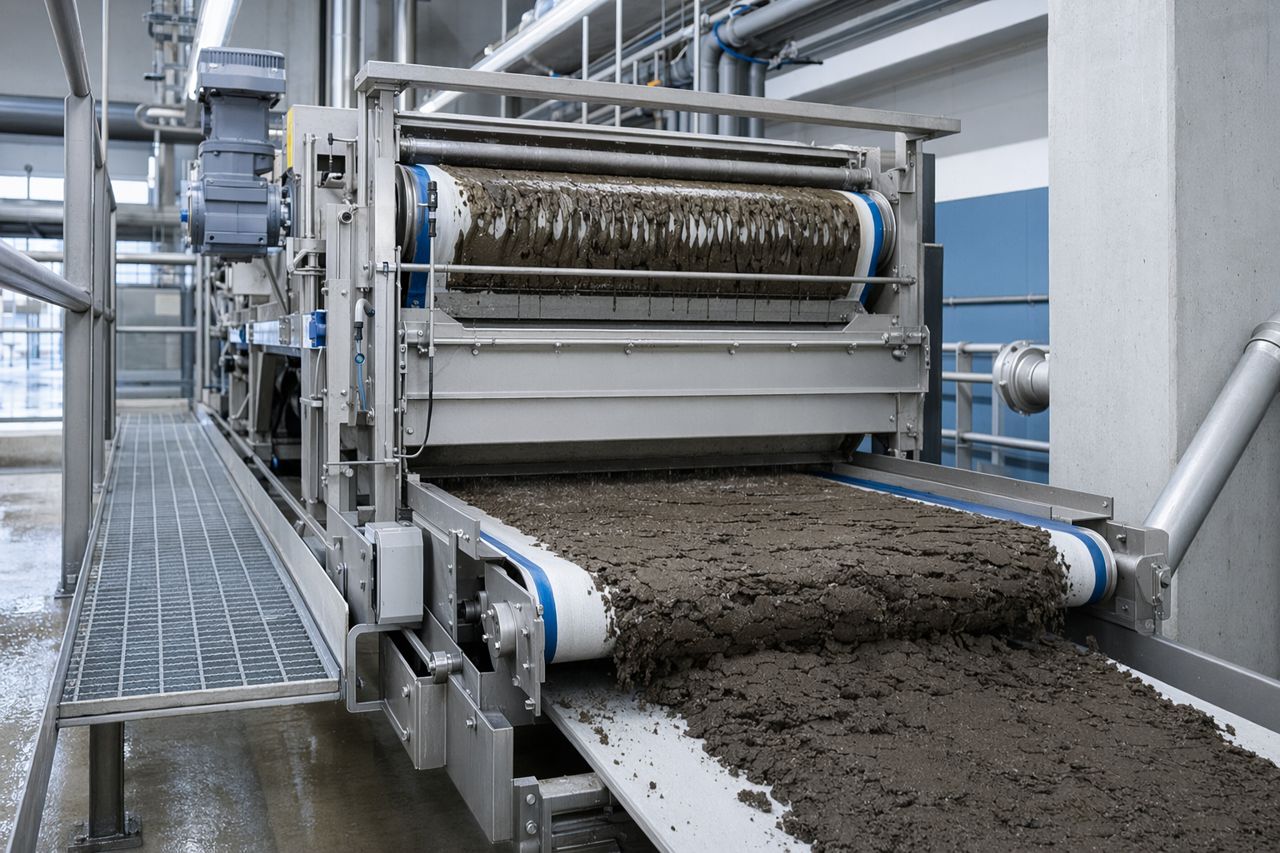
A belt press uses gravity drainage followed by progressive compression between moving belts. It gives operators a visible process: feed sludge, floc quality, drainage behavior, belt tracking, wash water performance, and cake release can all be observed.
Typical belt press advantages
- Operator visibility: Floc formation and drainage problems are easier to see.
- Gentler dewatering path: Lower shear can help preserve conditioned floc.
- Good cake control: Operators can adjust belt speed, pressure, polymer feed, and feed rate.
- Lower energy profile: Often attractive where power cost is a major operating concern.
- Accessible maintenance: Belts, rollers, spray bars, and drainage zones are open for inspection.
Typical belt press challenges
- More operator attention: Performance can drift if feed conditions change.
- Wash water dependence: Spray bars and belt cleaning must stay reliable.
- Odor and housekeeping exposure: The open design can require more containment discipline.
- Sensitive to poor floc drainage: If sludge holds water tightly, the gravity zone may struggle.
Conditioning implication
A belt press rewards sludge that drains early and forms visible, resilient floc. If industrial organics are making sludge greasy, sticky, slow-draining, or inconsistent, the plant may compensate with more polymer and operator adjustment. A targeted enzyme program upstream can sometimes improve how the sludge presents to the conditioning step, especially when fats, proteins, starches, or complex organic residues are part of the loading pattern.
Centrifuge sludge dewatering: what operators usually notice
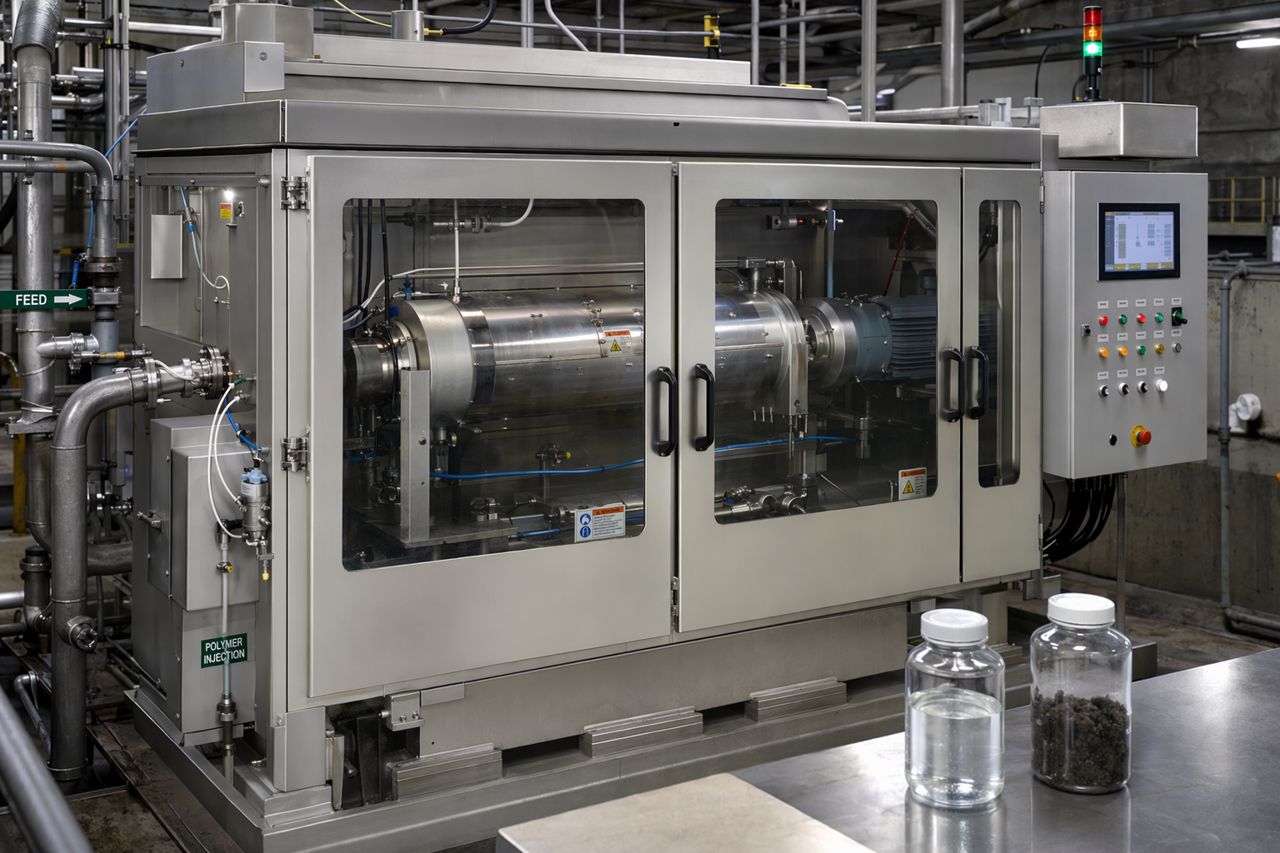
A centrifuge applies high rotational force inside an enclosed bowl. Solids are separated from liquid and conveyed out while centrate exits through the liquid path. It is compact, enclosed, and often attractive where space, odor control, or automation are priorities.
Typical centrifuge advantages
- Enclosed operation: Better containment for odor, mist, and housekeeping.
- Compact footprint: Useful where floor space is constrained.
- High throughput potential: Well-suited for continuous industrial duty when feed is controlled.
- Automation-friendly: Instrumentation and control logic can stabilize routine operation.
- Less visible mess: Cake and centrate are contained compared with open belt systems.
Typical centrifuge challenges
- Higher shear environment: Floc must survive intense mechanical stress.
- Polymer optimization can be narrower: Under-conditioned or over-conditioned sludge can quickly affect centrate quality and cake.
- Wear sensitivity: Abrasive solids or grit can increase maintenance demand.
- Less direct visual feedback: Operators often rely more on samples, trends, torque, vibration, and discharge observations.
Conditioning implication
A centrifuge rewards consistent feed and shear-resistant conditioning. If sludge composition changes rapidly, polymer settings may chase the process. Enzyme-assisted upstream conditioning may help where variable biodegradable organic loads are affecting viscosity, emulsion stability, or sludge structure before the centrifuge.
Solids capture: belt press vs. centrifuge
Solids capture depends on sludge type, polymer selection, equipment condition, feed consistency, and operator control.
Belt press
A belt press can deliver strong capture when floc forms well and drains evenly. Because the process is visible, operators can often spot pin floc, blinding, poor drainage, or cake release issues early.
Centrifuge
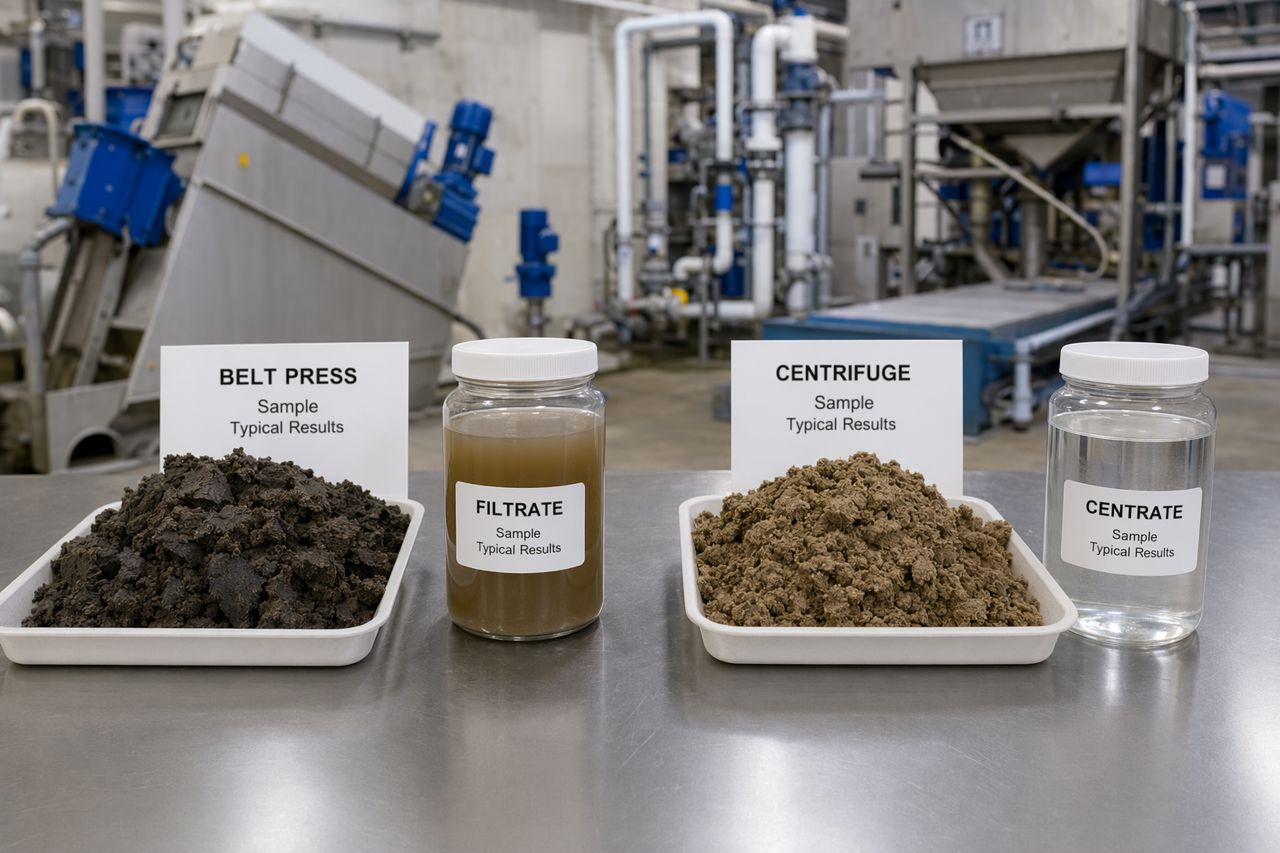
A centrifuge can deliver strong capture in a compact system, but performance can shift quickly when floc is not stable under shear. Small changes in feed solids, polymer response, or industrial chemistry may show up as cloudy centrate or softer cake.
Where enzyme blends may support capture goals
Bulk enzyme blends for industrial wastewater treatment are often evaluated when upstream organics interfere with settling, floc formation, or dewatering. The goal is not to force a single result, but to make the sludge more predictable so the existing conditioning program has less variability to fight.
Polymer dependence: different pressure points
Polymer is often one of the most visible consumables in sludge dewatering. The equipment type affects how polymer value is realized.
Belt press polymer behavior
On a belt press, polymer must create floc that drains in the gravity zone and holds together through compression. When sludge is slimy, oily, or overloaded with soluble organics, operators may increase polymer to recover drainage and cake release.
Centrifuge polymer behavior
In a centrifuge, polymer must create floc that survives shear and separates quickly. Too little conditioning can reduce capture. Too much can increase cost, create handling issues, or affect downstream centrate quality.
Practical buyer takeaway
If polymer use is rising without a clear mechanical cause, look upstream. Changes in production, cleaning cycles, food residues, pulp residues, fermentation byproducts, surfactants, fats, or protein-heavy streams can all change sludge behavior. Enzyme blends may be worth piloting when the plant needs a conditioning aid that addresses organic contributors before the dewatering machine.
Cake handling: dryness is not the only question
Cake that is slightly drier but sticky, stringy, odorous, or difficult to convey may still create cost. Cake handling should be evaluated as a total workflow:
- Does cake release cleanly?
- Does it bridge in hoppers?
- Does it smear on belts or conveyors?
- Does it create odor complaints?
- Does it affect hauling consistency?
- Does it require extra operator cleanup?
Belt press cake handling
Belt presses can provide more visual control over cake release. Operators can see whether cake is sticking to belts, cracking, or falling cleanly. However, open cake discharge may require more housekeeping.
Centrifuge cake handling
Centrifuge cake is discharged from an enclosed machine and may be easier to contain. However, if cake consistency changes quickly, conveying and storage systems can become the bottleneck.
Enzyme program relevance
Where organic loading creates sticky or greasy sludge, enzyme-assisted pretreatment can be evaluated as part of the broader conditioning plan. The commercial goal is practical: steadier cake behavior, fewer nuisance adjustments, and less disruption around hauling and disposal.
Shear: the major mechanical difference
Shear is one of the clearest differences between belt presses and centrifuges.
Belt press shear profile
Belt presses apply lower shear and progressive pressure. This can be forgiving for floc that is well formed but not extremely strong.
Centrifuge shear profile
Centrifuges expose sludge to intense acceleration and internal conveyance. Conditioning must be more shear-resistant, and upstream variability can be magnified.
Why this matters for enzyme blends
Enzyme blends are generally considered upstream of the mechanical dewatering step, not as a last-second fix inside the machine. If the sludge matrix becomes easier to condition before polymer addition, the final floc has a better chance of performing under the chosen mechanical stress profile.
Operator attention and process control
Belt press
A belt press often needs hands-on attention. Operators monitor floc, drainage, belt wash, cake release, and press adjustments. This can be an advantage in facilities with experienced staff, because the process gives visible feedback.
Centrifuge
A centrifuge can reduce open observation but increase reliance on instrumentation and sampling. Operators watch trends such as feed consistency, torque, centrate clarity, vibration, discharge quality, and polymer response.
Conditioning takeaway
If staffing is lean, consistency becomes more valuable. A sludge stream that behaves the same way each shift is easier to automate, easier to troubleshoot, and easier to quote from a chemical supply standpoint.
Feed variability: the industrial wastewater reality
Municipal sludge may have daily rhythms. Industrial wastewater can have sharper swings tied to production schedules, sanitation cycles, ingredient changes, batch dumps, raw material shifts, or maintenance events.
Common sources of variability include:
- Food and beverage residues
- Dairy, protein, starch, or sugar loading
- Fats, oils, and grease
- Pulp, fiber, and paper fines
- Fermentation and biotech residues
- Textile sizing and process aids
- Cleaning chemicals and surfactants
- Equalization tank turnover
Neither belt presses nor centrifuges perform their best when feed variability is ignored. Conditioning should begin with a review of what the sludge is made of, not only what the dewatering machine can do.
When to consider bulk enzyme blends for industrial wastewater treatment
A plant may consider enzyme blends when sludge dewatering problems appear connected to organic loading rather than purely mechanical failure.
Good evaluation triggers
- Polymer demand has increased after production changes
- Sludge is greasy, sticky, foamy, or slow-draining
- Cake handling varies by shift or production campaign
- Centrate or filtrate quality swings unexpectedly
- Operators are frequently adjusting feed rate or polymer
- Equalization and biological treatment are receiving difficult organic loads
- Hauling cost is sensitive to cake consistency
What a serious supplier should ask before quoting
A practical quote should be based on plant conditions, not generic promises. Expect questions about:
- Industry and production schedule
- Wastewater sources and major organic contributors
- Current dewatering equipment
- Sludge holding time and mixing
- Existing polymer program
- Pain points: capture, cake, odor, drainage, polymer use, or variability
- Desired packaging, delivery schedule, and storage conditions
- Trial scope and success criteria
Belt press vs. centrifuge: quick comparison table
| Variable | Belt press | Centrifuge |
|---|---|---|
| Process visibility | High; operators can see drainage and cake | Lower; more enclosed and instrument-driven |
| Shear environment | Lower to moderate | High |
| Footprint | Larger open layout | Compact enclosed layout |
| Operator attention | More visual adjustment | More trend and sample based |
| Polymer sensitivity | Strongly tied to drainage and cake release | Strongly tied to shear stability and capture |
| Feed variability response | Operators can often see changes quickly | Changes may show up as centrate or cake shifts |
| Housekeeping | More open exposure | Better containment |
| Maintenance focus | Belts, sprays, rollers, tracking | Bowl, scroll, wear parts, vibration |
| Conditioning priority | Drainable floc and clean release | Shear-resistant floc and consistent separation |
How to choose the conditioning strategy
The equipment comparison matters, but the better question is: what is the sludge asking the conditioning program to solve?
If you run a belt press, focus on:
- Gravity drainage behavior
- Belt blinding or wash performance
- Cake release
- Polymer response by shift
- Sticky or greasy solids
- Operator adjustment frequency
If you run a centrifuge, focus on:
- Feed consistency
- Floc shear stability
- Centrate clarity trends
- Cake discharge consistency
- Torque and vibration changes
- Polymer control window
For both systems, focus on upstream organics
If difficult organics are driving variability, changing the dewatering machine may not solve the root cause. A bulk enzyme blend can be evaluated as part of a broader plant strategy to make sludge easier to condition before it reaches the press or centrifuge.
Request a quote for an industrial wastewater enzyme blend
If your plant is comparing belt press and centrifuge performance—or trying to stabilize sludge conditioning after feed changes—we can help scope a practical enzyme blend quote for your wastewater process.
Use the on-site request a quote form and share your dewatering equipment type, current pain points, sludge characteristics, and desired supply format. Our team will respond with application-focused next steps for bulk supply evaluation.